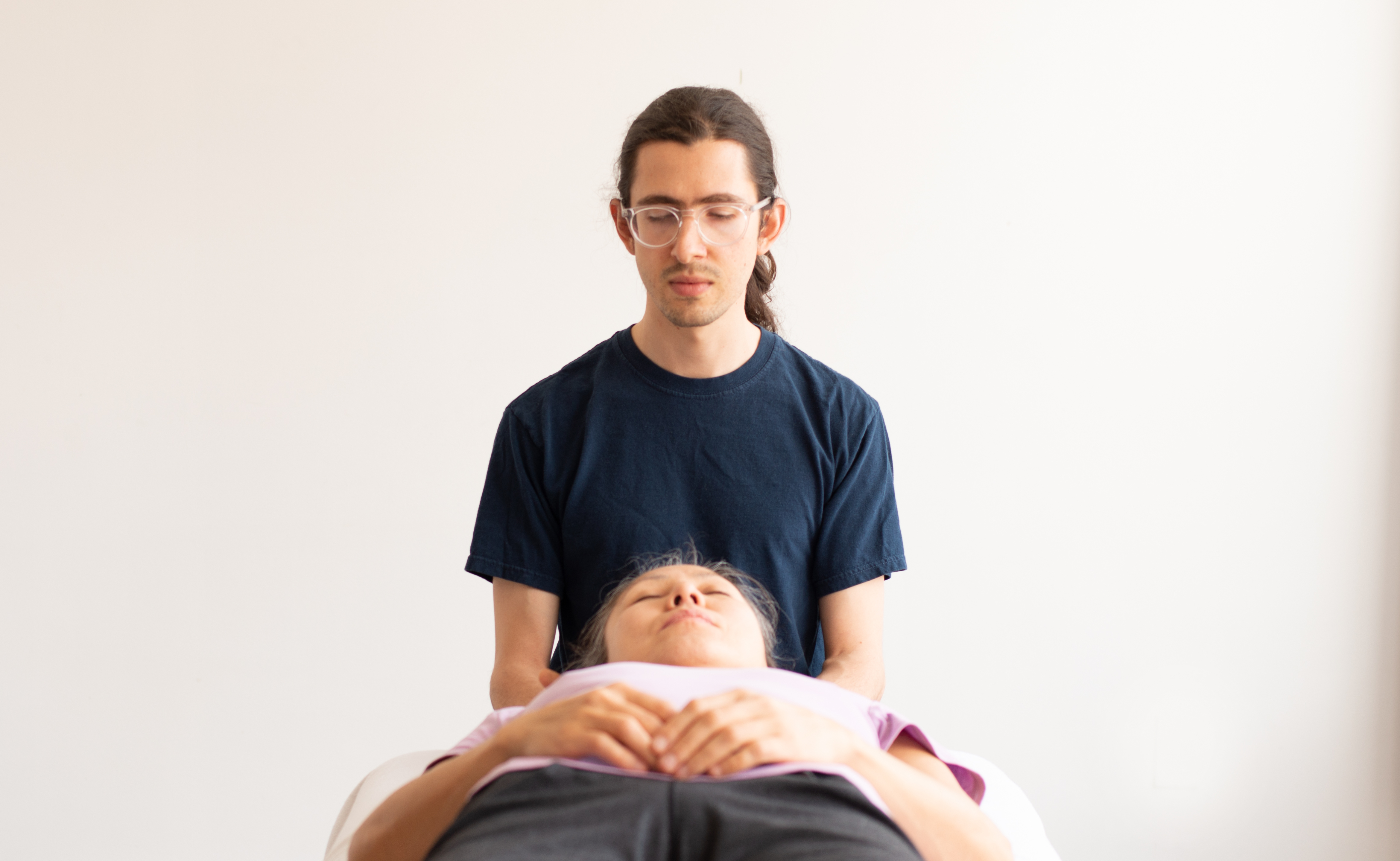
Moving from Object to Subject
The body is often treated as an object. Something to be corrected, silenced, forced back into productivity. We work differently.
Here, the body is a subject to be heard. It is a landscape that carries the sediment of your history. Every tension, every restriction, every pain point is a chapter of your biography written into your biology. The session is a container. We do not force the tissue. We wait for it to welcome us.
What Happens in a Session
Signal
We begin with conversation. You tell me where you are. I listen for what’s beneath the telling: the places where language tightens, the gaps, what your hands do while you speak. Together we find a bearing. What is this hour for?
This is already the work. The body speaks before the hands arrive.
Perimeter
Before depth, we establish ground. This is nervous system work, fully clothed if needed, finding the parts of you that are still at rest. Islands: places in the body where the soil is solid, where something is growing undisturbed. We anchor there first. The whole ecology needs to know it has solid ground before anything can shift.
Sometimes this means standing work. I may teach you a qigong form, a way of moving that invites the breath to settle lower, the weight to find the feet, the spine to remember its own length.
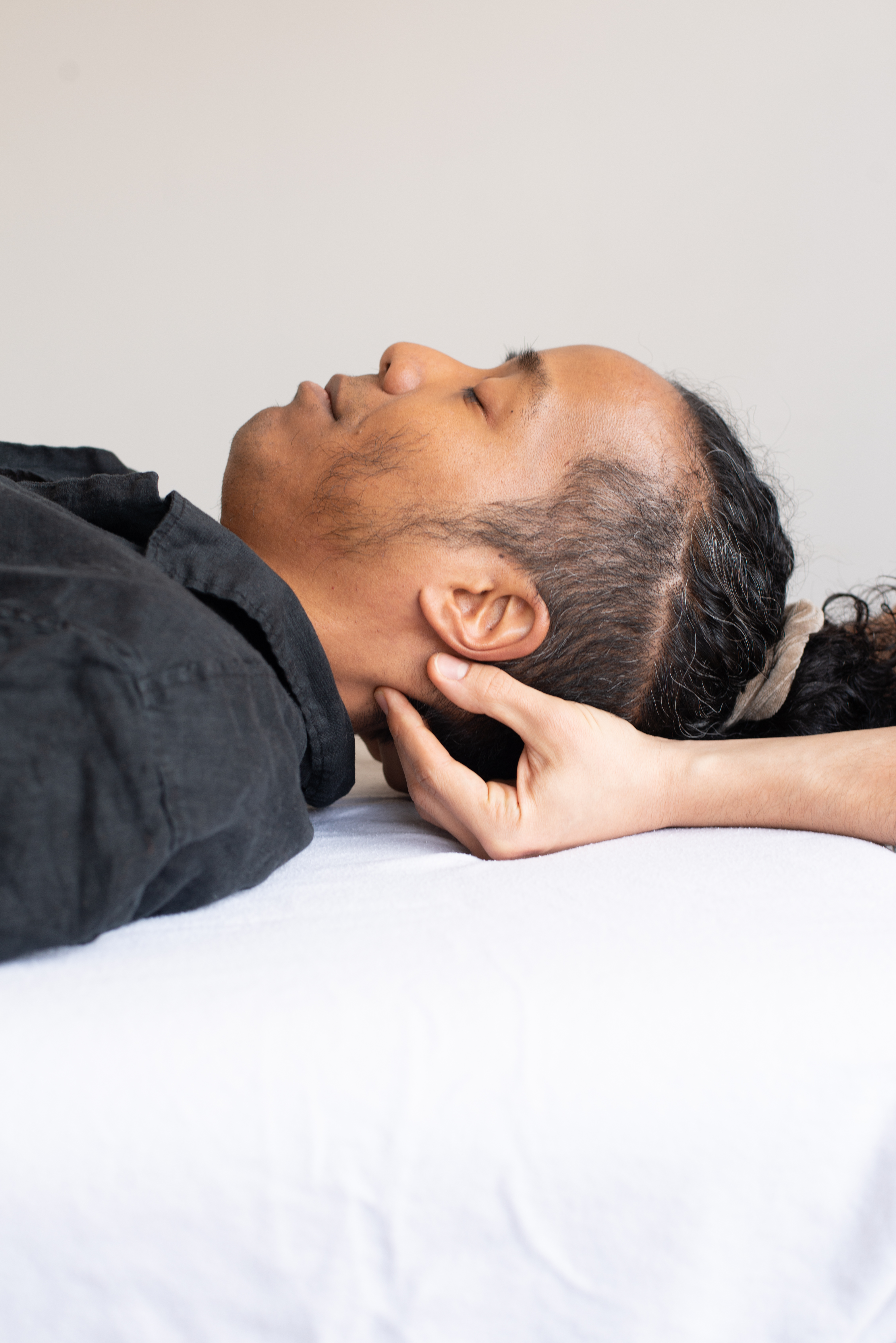
Hands-On Work
If you’re on your stomach, I begin with your back line: the spine, the fascia, the channels that run alongside it. This is tuina. Deliberate, slow, weighted. My hands follow the rhythm of your breath. Each exhale is an invitation to let the tissue soften, for the body to give a little more of its weight to the table, to gravity.
We turn, or don’t. Language tends to fall away on its own. I’ll name what I notice, not to explain, but to offer a door. Can you feel this letting go? Where does your breath go when I’m here?
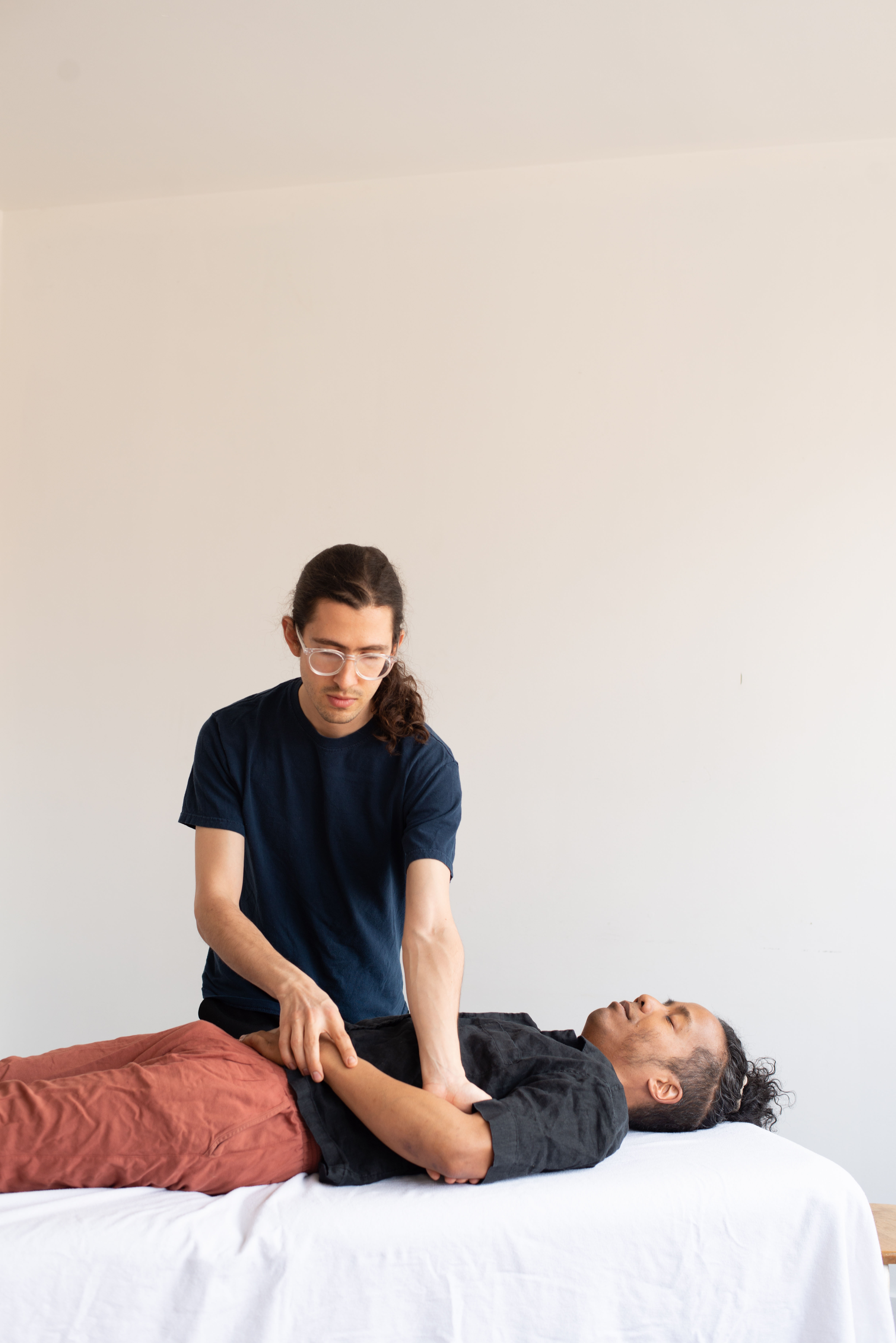
Then the unwinding begins. I’ll take a limb, your arm, your leg, and hold it, supporting its full weight so you don’t have to. And I follow. The limb has its own impulses, its own small movements, rotations, reaches. You may be aware of them, or you may have dropped below the surface of monitoring. You may not know who is moving. That’s right. It’s a conversation happening between your nervous system and my hands, and the question of who leads dissolves. Like a dance where both partners are listening so closely that the distinction between leading and following becomes irrelevant.
I might spend fifteen minutes with one arm. It depends on what surfaces. The limb spirals, pauses, reorganizes. I’m not directing it. I’m offering it the conditions to find its own resolution, a more spacious way of resting in gravity.
When catharsis comes, I hold. Hands behind the head. Palms beneath the sacrum. A hand on the heart. Or if what your body needs is resistance, something to push against, I meet it with equal weight. Yielding and returning, the way a good partner receives force without collapsing and without escalating. Presence, matched.
How People Respond
Most people relax deeply. Some reach something that has been gathering for a long time.
People leave saying they feel taller. Lighter. That something has shifted in how they carry their own weight. They’re right. Gravity hasn’t changed, but their relationship to it has.
The Harvest
We close with integration. You don’t leave mid-current. We take time to let what moved settle into a new arrangement, the way a landscape looks different after rain. The contours haven’t changed, but the light has. Something that was dry is saturated. Something that was buried has surfaced.
This may be silence. It may be a few words. It is always unhurried. The biology needs time to digest the biography.
The Four Lineages
Tuina
Tuina is often misunderstood as “Chinese massage.” It is closer to Chinese osteopathy, a complete system rooted in the internal martial arts. My training in jin shou tuina comes through the Montreal Gongfu Research Center, from Ethan Murchie, who received it from Vince Black, a direct student of Master Xu Hongji. In this tradition, the body is a hydraulic system. Pain is often a blockage, a rock in the river, that prevents the qi from irrigating the tissue. We don’t smash the rock. We use leverage, fulcrums, and alignment to open the channel.
Marma
Marma points are crossroads. Places where structure meets consciousness, where fascia, vessel, and nerve converge. Marma work reads these nodes as sites of tissue memory, places where the body’s history has condensed. The touch is precise, often still. We wait for the point to speak. The response isn’t local: a marma at the foot can reorganize the breath.
Craniosacral Therapy
If tuina clears the river, craniosacral therapy listens to the current.
A gentle, profound process of listening to the subtle rhythmic pulsation of the cerebrospinal fluid that bathes the central nervous system. When a body has been under chronic stress, this rhythm becomes jagged or faint. Through light touch and stillness, I offer a non-invasive presence. I wait for the system to speak, for the still point, the moment the nervous system shifts from vigilance to rest. It is there, in quiet observation, that deep repair occurs.
Somatic Education
I am not the expert on your sensation; you are. Drawing on Eugene Gendlin’s Focusing, I guide you to listen to the felt sense, those vague, subtle bodily signals that live below the level of words. We move from “I have a pain” to “I am sensing a tightness that feels like…” Drawing on contact improvisation and the Alexander Technique, we replace the judgment of “my neck is bad” with the inquiry of “how am I holding myself against gravity?”
Logistics
Rate: $100 / 60 minutes · $140 / 90 minutes · Sliding scale available. See pricing →
First session: May run longer to allow for a complete anamnesis.
Attire: Loose, comfortable clothing that allows for breath and range of motion. This is not oil-based table work. You are clothed throughout.
Insurance: Massage therapy receipts available for providers that cover these services.
Cancellation: 24 hours notice required. Less than that, the session fee stands.